Main menu

Have you ever felt that getting lost in the details of a crisis can drain your creative spirit before it even touches your material resources? When superficial solutions fail to bridge the gaps of failure, the Ishikawa (Fishbone) Diagram for Solutions shines as a beacon, reordering the chaos of your scattered ideas and revealing hidden perspectives.
But diagnosis alone is not enough. Skillfully combining it with the 5 Whys technique allows you to dive deep into the heart of the truth and excise pain at its root.
In the lines ahead, we open a door to transforming your philosophy in facing challenges. Read on to discover how to turn complexity into dazzling success, guided by emotional intelligence in leadership and a systematic approach to root cause analysis.
When Should We Move from the “5 Whys” to the Fishbone Diagram?
The heart of a leader races when faced with a problem too complex for conventional solutions. The mind searches for a compass to pinpoint the true root of the issue. When a single thread no longer suffices, it’s time to widen your perspective and use more holistic tools. Here, we outline the key differences that help you choose the right approach, whether the 5 Whys or the Ishikawa (Fishbone) Diagram for Solutions:
Pros and Cons of the 5 Whys Technique
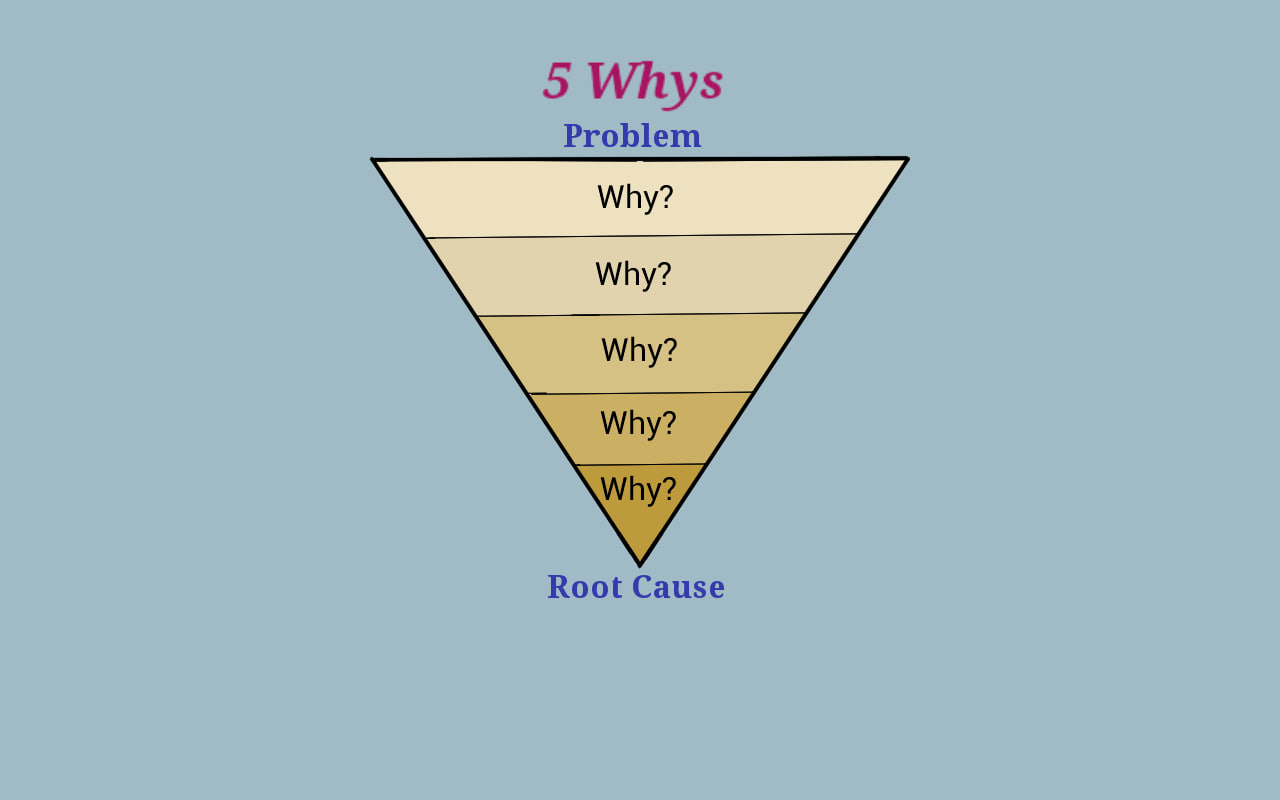
This technique is characterized by its remarkable simplicity, as it digs deeply along a single causal path until it reaches a root cause analysis of the problem. However, it may falter when threads become entangled, leading the analyst to narrow their thinking and overlook critical external factors. Author Eric Ries, in his renowned book The Lean Startup, emphasizes that its effectiveness lies in quickly and clearly addressing recurrent operational errors.
When the Ishikawa Diagram Excels in Complex, Branching Problems?
The intelligence of the Ishikawa (Fishbone) Diagram for Solutions becomes evident when a problem resembles an octopus, its impact stretching across multiple departments simultaneously.
This tool allows you to categorize chaos into clear segments - such as People, Machines, Environment - preventing small but critical details from being overlooked. Management research indicates that using this diagram also boosts team spirit, as each member can see how their area contributes to the emergence or resolution of the issue.
"The 5 Whys technique is ideal for problems with a single causal path, while the Ishikawa (Fishbone) Diagram for Solutions is preferred when multiple interrelated causes are involved, such as Machines, People, and Materials. Combining both tools ensures that no human or technical dimension is overlooked, thereby enhancing professional and leadership success)".
Roadmap: How to Integrate Both Tools in a Single Session?
Success in crisis management requires patience and the ability to align human emotion with the strict logic of technical data. When you sit down with your team, remember that the goal is not to assign blame, but to build a bridge of shared understanding that guides everyone toward a safe shore.
To achieve this outcome, we will outline a plan that combines the analytical power of both tools - the 5 Whys technique and the Ishikawa (Fishbone) Diagram for Solutions - in a single session. Here are the actionable steps to turn this integration into tangible results:
1. Clearly Identify the “Symptoms” of the Problem
The journey begins with an honest acknowledgment of a gap, describing the problem accurately, free from personal assumptions or biased emotions. Frame the issue in a concrete, actionable statement, such as: “Production decreased by 15% last month.” This precise definition guides the Ishikawa (Fishbone) Diagram for Solutions toward the correct target, avoiding wasted time on side discussions and setting the stage for effective root cause analysis.
2. Draw the “Fish Head” and Define the Main Categories
Place the core problem at the “head of the fish” and begin branching out the major “bones” representing key work areas suspected of underperformance. This stage helps structure collective thinking and ensures that no technical or human aspect - which could be a hidden cause - is overlooked. Here, the importance of Total Quality Management (TQM) emerges as an organizational framework that ensures a comprehensive investigation across every corner of the institution.
3. Apply the 5 Whys to Each Sub-“Bone” to Reach the Root
Here lies the ingenious touch: rather than stopping at identifying general causes, you begin asking “Why?” five times for each sub-cause that appears on the fishbone. This deep cross-examination ensures that the proposed solutions address the root of the problem, not just its superficial symptoms, saving the considerable costs often wasted on temporary fixes. At this stage, leveraging the Ishikawa (Fishbone) Diagram for Solutions transforms the investigation into an engaging, scientific, and well-documented process.
"The solution begins by drawing the Ishikawa (Fishbone) Diagram for Solutions to categorize potential causes, and then applying the 5 Whys technique to each selected cause. This combination demonstrates that the cause-and-effect relationship is not random, but a logical connection supported by tangible evidencex)".
Analysis and Interconnections: Demonstrating Effectiveness Through Numbers and Stories
The power of this methodology does not lie solely in the elegance of its geometric structure but in its remarkable capacity to transform failure into lessons of enduring value. When employees observe management employing the Ishikawa (Fishbone) Diagram for Solutions, accountability shifts toward evidence-based reasoning rather than subjective impressions.
Now, let us reflect on the profound impact this approach leaves on organizational structure and the psychological well-being of the institution:
Immediate Outcomes: A Significant Reduction in Problem-Solving Time
Case studies in the healthcare sector demonstrate that integrating both tools has helped reduce medical errors by more than 30% in some leading hospitals worldwide. A real-world case published in BMJ Open Quality revealed that analyzing medication errors through this combined approach uncovered a flaw in the supply system, rather than negligence on the part of nurses. This finding confirms that the Ishikawa (Fishbone) Diagram for Solutions plays a vital role in protecting human resources from professional injustice through structured root cause analysis.
Indirect Outcomes: Enhanced Employee Loyalty and Greater Competitive Advantage
This approach strengthens leadership's emotional intelligence, as employees feel their voices are heard and that problems are addressed with transparency and shared accountability. As stress caused by recurring issues decreases, levels of creativity and loyalty naturally rise, granting the organization a significant competitive advantage. Adopting the Ishikawa (Fishbone) Diagram for Solutions is therefore not merely a technical procedure, but a strategic investment in human capital and the creation of an inspiring work environment.
"The absence of this dual analysis leads to imprecise managerial decisions and a loss of motivation. In contrast, applying it enhances collective performance and fosters a humane work environment that attracts talent and prevents burnout).

Frequently Asked Questions
1. Should both tools always be used together?
Not necessarily. Use the 5 Whys technique for simple, linear problems, and turn to the combined approach when you notice that an issue keeps recurring despite previous solutions.
2. How can I maintain team morale when examining the “People” branch of the fishbone?
Focus on processes rather than individuals, use empathy-driven language, and connect your reasoning to shared values. This ensures that team members do not feel personally attacked and helps preserve psychological safety.
3. What is the biggest mistake when using the Ishikawa Diagram?
Stopping at superficial causes. This is where the 5 Whys technique becomes essential, challenging false assumptions, dismantling weak arguments, and guiding the analysis toward the true root cause.
In Conclusion
The Ishikawa (Fishbone) Diagram for Solutions, supported by the 5 Whys technique, remains the most powerful tool in a leader's hands who strives for operational excellence. By uniting analytical rigor with an empathetic mindset, this integration marks the difference between a company that survives on temporary fixes and one that thrives through health and sustainability.
Start applying this combined approach to your next challenge, and watch complexity begin to dissolve.
This article was prepared by trainer Khaled Abo Seif, certified coach from Wolfa Academy.